Showing posts with label Science and Tech. Show all posts

Saturday, January 28, 2012

The mouse that tweets like a bird: Japanese scientists create genetically-modified animal

By DAILY MAIL REPORTER

A mouse genetically engineered to tweet like a bird has been created in Japan

Japanese scientists have produced a genetically-engineered mouse that tweets like a bird, it was revealed today.
A team of researchers at the University of Osaka are breeding genetically modified mice that are prone to miscopying DNA and are more likely to develop mutations.
The 'tweeting' mouse was created as part of the team's ‘Evolved Mouse Project. They hope it will shed new light on how languages evolve.

‘Mutations are the driving force of evolution. We have cross-bred the genetically modified mice for generations to see what would happen,’ lead researcher Arikuni Uchimura said.
‘We checked the newly born mice one by one... One day we found a mouse that was singing like a bird,’ he told AFP.
He said that the ‘singing mouse’ was born by chance but that the trait will be passed on to future generations.
‘I was surprised because I had been expecting mice that are different in physical shape,’ he said by telephone
The project has also produced ‘a mouse with short limbs and a tail like a dachshund’.
The laboratory, directed by professor Takeshi Yagi at the Osaka University’s Graduate School of Frontier Biosciences in western Japan, now has more than 100 ‘singing mice’ for further research.
The team hopes they will provide clues on how human language evolved, just as researchers in other countries study songbirds such as finches to help them understand the origins of human language.
‘Mice are better than birds to study because they are mammals and much closer to humans in their brain structures and other biological aspects,’ Uchimura said.

source: dailymail

Wednesday, January 25, 2012

Man's best friend for 30,000 years: Canine skulls discovered in two separate digs reveals historic relationship

-Teeth and jaws show animal was domesticated
-One of the oldest domesticated dogs ever found
-Hints that man may have domesticated dogs in several places - all dogs aren't evolved from one ancestor

By ROB WAUGH

The Altai skull was particularly well preserved, and allowed researchers to measure its teeth, jaws and snout for evidence it was domesticated

Dogs have been a loyal companion to mankind for more than 30,000 years, findings reveal. Scientists believe that two 33,000-year-old skulls unearthed in digs in Siberia and Belgium show dogs were domesticated long before any other animal, such as sheep, cows or goats.
Researchers from the University of Arizona said the skulls had shorter snouts and wider jaws than undomesticated animals such as wolves, which use their longer snouts and narrower jaws to help them hunt.
That suggested the dogs had been kept for protection and companionship by our ancient ancestors – just as they are today.

Recent DNA research hinted that all dogs came from a single wolf-like ancestor - but the Altai find may prove that isn't so

The researchers think dogs could have been the first species of animals to be domesticated by humans, long before farm animals were bred for their meat and skins.
This offers a possible explanation for why breeds such as pugs and huskies look so different, despite being the same species.

The scientists used carbon dating to determine the age of the two skulls, then looked at the bone structures and concluded that claims the dogs had been domesticated were ‘pretty solid’.
Study author Dr Greg Hodgins, whose findings were published in the journal PLoS ONE, said: ‘Both the Belgian find and the Siberian find are domesticated species based on morphological [structural] characteristics.
‘Essentially, wolves have long thin snouts and their teeth are not crowded, and domestication results in this shortening of the snout and widening of the jaws and crowding of the teeth.

source: dailymail

Saturday, January 21, 2012

'Dracula' monkey comes back from the dead in Borneo

By ROB WAUGH

One of the rarest and least known primates in the world, Miller's Grizzled Langur, has been found in Borneo - despite the fact that it was thought the species had been wiped out in 2004

An 'extinct' monkey has been rediscovered in the rainforest of Borneo by an international team of scientists on a new expedition.
One of the rarest and least known primates in the world, Miller's Grizzled Langur, has been found alive - it was thought the species had been wiped out in 2004. The species has a distinctive dark face and white, Dracula-esque 'collar' of fur.
Some of the only photos in existence of the rare animal were snapped by camera traps and have provided the first solid evidence that it is still alive.

Some of the only photos in existence of the rare animal were snapped by camera traps and have provided the first solid evidence that it is still alive and well

The endangered monkey was discovered living in the Wehea Forest, East Kalimantan, Borneo, a largely undisturbed rainforest where it was previously not known to exist.
Brent Loken, from Simon Fraser University Canada, said: 'While our finding confirms the monkey still exists in East Kalimantan, there is a good chance that it remains one of the world's most endangered primates.'
'I believe it is a race against time to protect many species in Borneo. It is difficult to adopt conservation strategies to protect species when we don't even know the extent of where they live.'

Brent Loken, from Simon Fraser University Canada, said: 'While our finding confirms the monkey still exists in East Kalimantan, there is a good chance that it remains one of the world's most endangered primates.'

The Miller's Grizzled Langur is part of the small primate genus Presbytis, found across Borneo, Sumatra, Java and the Thai-Malay Peninsula.
In Borneo, it was only found in a small corner of the county's north east and its habitat has suffered from fires, human habitation and conversion of land for agriculture and mining.
But the team of scientists stumbled upon the monkey when trekking through the 38,000 hectare rainforest which contains at least nine known species of non-human primate, including the Bornean orangutan and gibbon.

source: dailymail

Saturday, January 14, 2012

Massacre in the hive: Amazing footage of 30 giant Japanese hornets slaughtering 30,000 tiny honeybees to eat their young

By GAVIN ALLEN

Fight! A poor honeybee (left) comes face to face with a giant Japanese hornet on the doorstep of its own hive in the prelude to a massacre

Tens of thousands are dead, hundreds more of the dying lie writhing on the battlefield, powerless to protect their children.
These horrifying and yet fascinating scenes are the highlights of a three-hour battle between just 30 giant Japanese hornets and 30,000 European honeybees.
The video, from a National Geographic documentary called Hornets From Hell, shows a full-scale attack on the honeybees' comb in order that the hornets can get at their larvae.

Slaughter: Thousands of honeybee corpses litter the ground beneath the hive as the hornets hover over the entrance to the hive to continue the killing

The mass slaughter is possible because the European honeybees did not grow up around the Japanese Hornets and thus have no defence against them.
Vespa velutina - the hornet's Latin name - is believed to have hit Europe in 2004 after hitching a ride to France on some pot plants transported from China.
In Asia, honeybees have learned to encircle an intruder and, by flapping their wings, cause it to overheat and die. But European bees have not had enough time to evolve an effective tactic.

Natural selection: A hornet drags a honeybee larvae from the comb and eats it, turning the meat into a gooey paste which it can feed to its own offspring

The hornets begin their attack by hovering in front of a beehive, picking off single honeybees, decapitating them and stripping off their wings and legs before making off with the 'meat ball', taking it back to the nest to feed their young.
Adult hornets chew the flesh of their victims into a sticky liquid that it feeds to its offspring.
However, the hornets then step up their attack, emitting a chemical rallying cry that indicates that return flights to the nest must stop.

Learn to share your food: After the massacre two exhausted and overheating hornets are seen sharing liquids to regain some energy

They they concentrate of the slaughter and with the honeybee stings simply not powerful enough to wound the hornets, up to 40 honeybees a minute can be killed.
After the massacre the hornets exchange liquids with each other to boost their energy.
They they fly unopposed into the comb to feed on the succulent and nutritious flesh of the gestating honeybee larvae.
The Japanese hornet is four times the size of our native honeybees and its sting has been compared to a hot nail being hammered into the body. They can fly up to 60 miles with a top speed of around 25 miles per hour.


source: dailymail

Thursday, January 12, 2012

Skull face sighted: First pictures of the snub-nosed monkeys who can't look up when it rains

By RICHARD SHEARS

Historic first: The Myanmar snub nosed monkey had not been previously been photographed until this group were spotted in the Kachin mountain jungles

A British wildlife photographer has managed to capture the first known picture of the extremely rare snub-nosed monkey of Burma. The creatures, whose faces resemble skulls, are so rare that they have only ever been seen once before by Western eyes, when the team did not have time to record the meeting. More commonly, dead bodies, skins and bones are all that is seen of them, usually after they have been hunted by villagers. The monkey gets its name from its peculiar turned-up nose, which causes problems for it when it rains - for all the water runs up its nostrils.

Night prowler: The monkeys triggered hidden cameras set up on the Burma-China border

As a result it constantly sneezes during the monsoon season and in order to avoid the rain keeps its face to the ground as much as possible.
Locals even call it mey nwoah (monkey with an upturned face).
But now Jeremy Holden, who works with Britain's oldest conservation organisation, Fauna and Flora International, has photographed a pair of them looking upwards in colour. He also spotted them with their young in the remote mountain jungles of Kachin, on the border of Burma and China.
'It's the first time the monkey has been photographed,' said a proud Mr Holden,

Excited: The pictures by Briton Jeremy Holden have set the scientific community abuzz

'We didn't know where they lived and I didn't hold out much hope of short-term success with this work.'
But then a small group of monkeys walked past the hidden cameras that he had set up to shoot pictures at any sign of movement. What excited the scientists was the discovery that some of the females were carrying babies.
Mr Holden worked with scientists linked to the Biodiversity and Nature Conservation Association and another group called the People Resources and Conservation Fundation.

source: dailymail

Smallest vertebrate in the world found in Papua New Guinea: Frog measures just 7mm

By TAMARA COHEN

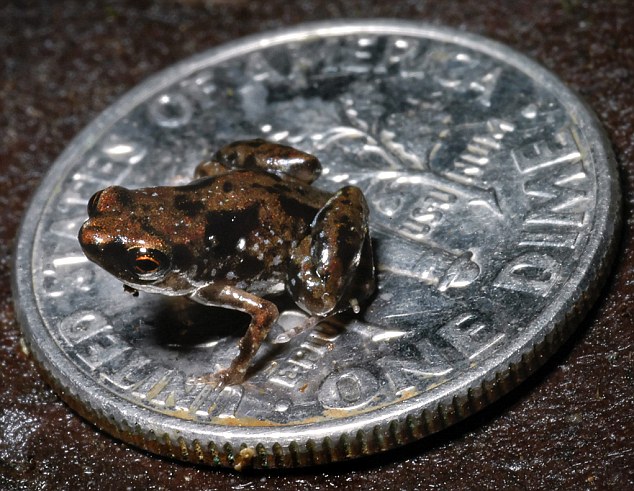
Miniscule: This tiny frog, believed to be the smallest vertebrate on Earth, has been discovered by scientists in Papua New Guinea

Perched on a coin the size of a 5p piece, there is still probably room for two.
At half the size of a Smartie sweet, this is the world’s smallest frog, measuring just a quarter of an inch long.
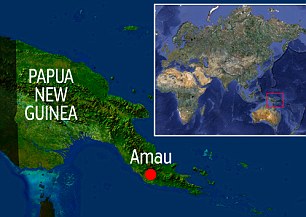
Scientists discovered the previously unknown creature, speckled in red and black, sitting on a leaf on the tropical island of Papua New Guinea.
At just 7.7mm in size when fully grown, it has snatched the title as the smallest of the world’s 60,000 vertebrates – creatures with a backbone – previously held by a tiny Indonesian fish which measures 7.9mm.

The tiny creature was discovered in Amau, Papua New Guinea

Experts are baffled by the find as it was previously thought extreme body size in vertebrates, whether large or small, was associated with living in water.
Professor Chris Austin, of Louisiana State University, who discovered the frog on a three-month field trip to the Pacific island, said by contrast these creatures make their habitats on fallen leaves on the floor of tropical rainforests.

His discovery of the creatures, named Paedophryne amanuensis after a village called Amau near where they were found, will help scientists understand more about extreme body size, he wrote in the journal PLoS One. They are thought to have evolved ‘extreme miniaturisation’ to fill a hole in the food chain which was not being exploited by others, perhaps to eat minuscule creatures such as mites which would not sustain larger frogs.

It was no easy job to find one, but his team followed the high-pitched calls made by adult males when they are looking for a mate.
The tiny specimen fits comfortably on a US dime, which measures 17.9mm, slightly smaller the size of a 5p piece which measures 18mm.
Prof Austin said: ‘We now believe they aren’t just biological oddities, but instead represent a previously undocumented ecological guild - they occupy a habitat niche that no other vertebrate does. ‘It was particularly difficult to locate Paedophryne amauensis due to its diminutive size and the males’ high pitched insect-like mating call. ‘But it’s a great find.
New Guinea is a hotspot of biodiversity, and everything new we discover there adds another layer to our overall understanding of how biodiversity is generated and maintained.’

source: dailymail

Friday, January 6, 2012

Miracle or meddling? 'Chimeric' monkeys made from cells of six different 'parents' spark protests

By FIONA MACRAE

Scientists at the Oregon Primate Centre have created monkeys which each contain a cocktail of cells from other embryos. Scientists say they could help stem cell research - but animal campaigners are horrified

They may look like any other baby monkeys, but these two are scientific breakthroughs.
Roku and Hex are the world’s first chimeric monkeys – created with genetic material from six ‘parents’.
But their birth has caused an ethical storm, with critics accusing scientists of disregarding the welfare of the animals.

Roku and Hex: Named after the fire-breathing creature in Greek mythology composed of parts of multiple animals, chimeras are organisms made up of cells from two or more genetically distinct sources.

Named after the fire-breathing creature in Greek mythology composed of parts of multiple animals, chimeras are organisms made up of cells from two or more genetically distinct sources.
Twins Roku and Hex, whose respective names come from the Japanese and Greek for ‘six’, have been created with genetic material from six monkeys.
Researchers from Oregon Health and Science University in the U.S. extracted cells from six macaque embryos and combined them into a single embryo in a laboratory before implanting it into a surrogate mother monkey.

Roku: The monkeys were created by 'gluing together' cells from several other embryos

Three male babies were born using this process – Roku and Hex, who are twins, and Chimero.
However, to reach this stage, dozens more embryos were experimented on, and some surrogate pregnancies were aborted.
While most animals only contain cells in which the genetic material from their two parents has mixed together, the chimeric monkeys’ bodies contain six different types of cell – holding distinct DNA from each biological parent.

A 'chimeric' blastocyst cell: The monkeys were created from cells of six other embryos

Scientists at the Oregon Primate Centre have created monkeys which each contain a cocktail of cells from other embryos. Scientists say they could help stem cell research - but animal campaigners are horrified.

'The monkeys who do exhibit characteristics of ‘interest’ are destined to suffer greatly by their very nature, and via the experiments to which they will be subjected.'

'The cells never fuse, but they stay together and work together to form tissues and organs,' said lead scientist Dr Shoukhrat Mitalipov, from the Oregon National Primate Centre. 'The possibilities for science are enormous.'

source: dailymail

Proof that dogs really DO know what you're thinking - and they can understand as much as toddlers

By TED THORNHILL

Who's a clever boy? Dogs have similar cognitive skills to babies, say researchers

Dogs pick up not only on the words we say but also on what we mean when we say them - and they can even read our tone of voice.
Researchers found dogs' level of understanding is surprisingly similar to that of very young children.
Jszsef Topal, of the Hungarian Academy of Sciences, said: ‘Increasing evidence supports the notion that humans and dogs share some social skills.

'The way dogs work resembles that of a six-month to two-year-old child in a lot of respects.'
Dogs even watch how we make eye contact, to work out what we mean and why we are talking to them.
‘Dogs, as well as human infants, are sensitive to cues that signal our intent,' says Topal.

Innovative: Researchers used eye-tracking software to determine that dogs and toddlers respond in a similar manner to our commands

Topal's team tested dogs with videos of a person saying, 'Hi, dog!' in different tones of voice and using different levels of eye contact.
The dogs can 'read' the eye contact and enthusiasm as well as youngsters, the team found. Dogs know when they are being spoken to - and can even make a guess at what you are thinking.
Dr Topal said that the results will undoubtedly confirm what many dog owners and trainers already know.

source: dailymail

Welcome to a brave new world: Genetic scientists create freakish man-made monster ants with huge heads and jaws

By ROB WAUGH

A supersoldier next to a normal ant: Scientists say they can create the supersoldiers at will by dabbing normal ant larvae with a special hormone - the larvae then develop into supersoldiers rather than normal soldier or worker ants

Nightmarish 'supersoldier' ants with huge heads and jaws have been created by activating ancient genes.
Scientists believe the monster ants may be a genetic throwback to an ancestor that lived millions of years ago.
Scientists say they can create the supersoldiers at will by dabbing normal ant larvae with a special hormone - the larvae then develop into supersoldiers rather than normal soldier or worker ants.

Supersoldier ants can occur naturally in the wild, but only rarely. In the deserts of America and Mexico, their job is to protect the colony from raids by invading army ants.
The supersoldiers use their enormous heads to block the nest entrance and attack any enemy ants that get too close.

Scientists created the monster ants in the laboratory by activating ancient ancestral genes

Scientists showed that ordinary ants of the species Pheidole morrisi contain all the genetic 'tools' needed to turn them into supersoldiers - they just need a hormonal push.
The research is reported today in the journal Science.
Authors Dr Rajendhran Rajakumar, from McGill University, Canada, and colleagues wrote: 'We uncovered an ancestral development potential to produce a novel supersoldier subcaste that has been retained throughout a hyperdiverse ant genus that evolved 35 to 60 million years ago.'
The results suggest that holding on to ancestral development toolkits may play an important role in evolving new physical traits, say the researchers.

source: dailymail

Thursday, December 22, 2011

Out of this world: Winners of National Geographic competition capture stunning images of nature at its most beautiful

By NINA GOLGOWSKI


Winner: Splashing, the grand prize winning photo as well as Nature category winner, was taken in the city of Batam in Indonesia's Riau Islands


National Geographic announced their 2011 global-wide photography contest awarding not only a warm financial prize to its three winners but world-wide publication in their magazine.

The winners were taken from digital submissions on three categories of people, places and nature while judged by three National Geographic photographers.

The judges gave equal weight to both creativity and photographic quality when the deciding the winners, including the grand prize, first place winner to a photo of a dragonfly.


The water flinging dragonfly photo titled Splashing, was captured by Shikhei Goh, a photographer in Indonesia's Riau Islands while they were both caught in a sudden downpour.

It was described as a 'very striking macrophotography image that rose to the top of the nature category for me because of its originality, beautiful light, rare action in a close-up image, as well as its technical perfection,' according to judge Tim Laman to the National Geographic.


Glowing: Blue Pond & First Snow, by Kent Shiraishi, captured a famous tourist resort in Japan for the nature category's honorable mention as the hot spring ripples below white-frosted trees


According to judge Peter Essick, he said that the photograph gave the insect 'character us humans can relate to.'

'It's rare indeed to see a photograph that causes the viewer to feel a bond with a member of the animal world seemingly,' Mr Essick told the magazine, 'but maybe not, so unlike our own.'


Floating: The Sunrising Jellyfish, by Angel Fitor, received honorable mention in nature as it's caught just beneath the water's surface in Murcia province, Spain


Running: Photo, Panic in the Pan, by Marius Coetzee was taken during a safari in Tanzania's Serengeti National Park at a watering hole


Chase: Photo, The Hunt, by Stefano Pesarelli received honorable mention for its natural use of panning and balance in its capture of a scene at the Masai Mara National Reserve in Kenya


In the places category, a photo titled Into the Green Zone won for its capture of a rainbow bending over a smooth ocean at the Philippines' Onuk Island.

According to Mr Laman, the photographer George Tapan 'showed a perfect sense of timing and composition in the way he captured the two small human subjects in this beautiful scene, and that really made the shot.'

Mr Essick noted his captivation of the woman's hair over her shoulder as it, 'fills a fraction of the picture's real estate, but by capturing the movement at the apex, the photographer has documented a sense of style and flair.

'Small things can sometimes make a big difference,' he finished.


Winner: Into the Green Zone, by George Tapan, captured a rainbow after the rain at the Palawan Islands in the Philippines, winning the category of Places


Jumping: Photo, Sulfuric Fire Festival, by Hung-Hsiu Shih received honorable mention for its capture of fire fishing in Taipei


Flying: Flying Kites, by Felipe Carvalho, received honorable mention for its capture of a kite battle at the Santa Marta ghetto in Rio de Janeiro which for many years were used to alert drug dealers of approaching enemies


Falling: Anuar Patjane's Cyber Monsoon received honorable mention for its capture of a torrential monsoon rain in Bhaktapur, Nepal


Soaring: Waterway to Orbit, by James Vernacotola, displays the Space shuttle Endeavour flying into orbit over the Intracoastal Waterway in Ponte Vedra, Florida


For the category of People, a photo titled The Fjellman Family by Izabelle Nordfjell captures a Swedish reindeer hunter seeking food for his family using a rifle.

According to judge Amy Toensing, the photo captured a quick moment 'real and mysterious at the same time.'

'In the Sami culture,' Mr Essick added, referring to the hunter, 'these events are repeated many times every year, even though they are never quite the same. However, by using a careful composition and skillful timing, the photographer made this one encounter with a Sami hunter memorable.'


Winner: People category winner titled The Fjellman Family, by Izabelle Nordfjell, describes in one shot, literally and physically, one method of feeding a family in northern Sweden before a long winter


Dressed up: Photo titled Zombies, by Lisa Clarke, shows a young family dressed as zombies in Brisbane, Queensland around Halloween, receiving honorable mention for the People category


Driving: The photo titled Auburn Pride, by George Voulgaropoulos, shows young men driving along Auburn Road in a small suburb in Australia that's described as a common landing point for migrants


Posing: From Up Here, by Helen Pearson, shows the Huntsville rap duo G-Side on a fire escape in Manhattan which shows today's independent music scene according to the caption


The grand price winner of the National Geographic contest, Shikhei Goh for his photo titled Splashing, wins $10,000 in addition to a paid trip to Washington D.C. to attend a photography seminar and tour of their building.

His photo will also appear in the National Geographic magazine.

The first place winners in each of the other categories, People and Places, receives $2,500 along with their photo published in the magazine.

View the rest of the contest's honorable mentions as well as the full-gallery of submissions on the contest's website: www.ngphotocontest.com


source: dailymail

Friday, December 9, 2011

Nature at its most savage: The shocking pictures that prove polar bears are cannibals - and will even eat bear cubs

By ROB WAUGH


A polar bear drags the corpse of a tiny polar bear cub that it has caught and killled. Bears usually hunt seals, but will attack and eat their own kind


They are known to be ruthless killers. But this scene proves polar bears will even attack and eat their own kind, even if it's a defenceless cub.

Photographer Jenny Ross captured the shocking images and at first thought the bear was eating a seal as she approached by boat.

There was another polar bear nearby, and Ross believes that this could have been the cub's mother.


Cannibalism is not unknown in polar bears - but scientists have recently observed that the behaviour is on the increase among the animals


Shockingly, this behaviour is becoming increasingly common among the bears, according to Ross's research.

'As soon as the adult male became aware that a boat was approaching him, he basically stood to attention - he straddled the young bear's body, asserting control over it and conveying 'this is my food,' said Ross.


Ross said that the bear stood up defensively as she approached - and draggged its tiny victim to another ice floe to ensure it could continue enjoying its meal


'He then picked up the bear in his jaws and, just using the power of his jaws and his neck, transported it from one floe to another. And eventually, when he was a considerable distance away, he stopped and fed on the carcass.'


As Ross approached, the bear stood up 'to assert dominance' over the carcass - and warn her off from stealing the bear's 'meal'


It's been known that polar bears do kill - and sometimes eat - their own kind for some time. But the behaviour appears to be on the increase.

Ross's research is published in a paper in the journal Arctic, 'During breakup and melting in summer, the area of sea ice around the Svalbard Archipelago declines to a fraction of the winter total, and in many areas it disappears completely.'

'As the area of sea ice that polar bears can use for hunting declines, progressively fewer seals are accessible to the bears, and therefore the bears' hunting success likely declines as well.'

'Thus, at this time of year, young polar bears may represent a possible food source for adult males. As the climate continues to warm in the Arctic and the sea ice melts earlier in the summer, the frequency of such intraspecific predation may increase.'


'Predating another bear is a way to get food; it's probably a relatively easy way for a big adult male. And it seems that because of the circumstances of the loss of sea ice - that kind of behaviour may be becoming more common,' says Ross


'On land, they're looking for human garbage and human foods; they're starting to prey on seabirds and their eggs,' Ross told the BBC. 'None of those alternative foods can support them.'


Pictured in the Barents Sea, Svalbard Archipelago, it's the first known photo of polar bear cannibalism on the sea ice


As Ross's boat approached, the bear dragged the carcass away


Polar bears are known to be violent - and occasionally cannibalistic - but scientists believe this behaviour is increasing as their habitat comes under threat


'Predating another bear is a way to get food; it's probably a relatively easy way for a big adult male. And it seems that because of the circumstances of the loss of sea ice - that kind of behaviour may be becoming more common.'


source: dailymail

Thursday, December 8, 2011

Chimps 'trade' just like humans - and some even indulge in 'the oldest profession'

A western common chimpanzee (Pan troglodytes verus) of the type that the scientists observed. 'Trade' was common among the chimps - and their relationships were much more 'human' than many of us might care to admit


Chimps have been known to share meat when they find a large carcass, but scientists observing the animals in the wild in Senegal found that chimps 'share' far more than previously thought.

Chimp communities involve so much trade - and such complex relationships - that they are much more like our societies than many of us would care to admit.

Te chimp 'market' that the scientists observed saw chimps sharing food and tools 41 times - in exchange for 'social favours'.


The relatively 'complex' lives of the Fongoli chimps - they hunt other animals with spears and shelter in caves - may heighten the frequency of trade among the animals


On 27 occasions, male savannah chimps in the Fongoli area of south-east Senegal gave females food and tools.

On several occasions, the trade wasn't quite what you'd imagine of a human 'deal' - it was simply that the male chimp didn't resist when a female ran off with something.

Fongoli males outnumber females - so they have to be polite if they want to have a chance with the other sex, and 'politness' among chimps, it seems, extends to handing over fruit and tools.


Overall, the researchers observed 41 'trades' between the chimps - and say that the extent of the trade shows that the animals are more 'human' than we thought.

The relatively 'complex' lives of the Fongoli chimps - they hunt other animals with spears and shelter in caves - may heighten the frequency of trade among the animals.

It also might offer a glimpse into the past of our own species.


source: dailymail

Twitter Delicious Facebook Digg Stumbleupon Favorites More

 
Design by Free WordPress Themes | Bloggerized by Lasantha - Premium Blogger Themes | Grants For Single Moms