Showing posts with label Penguin. Show all posts

Friday, January 27, 2012

There's something p-p-peculiar about him: Rare white penguin spotted in Antarctica

By DANIEL MILLER

This rare all-white Chinstrap penguin stands out against his friends as he takes his morning waddle around Antarctica

This rare all-white Chinstrap penguin stands out against his friends as he takes his morning waddle around Antarctica.
The unusual bird was photographed by naturalist David Stephens during a nature expedition to the Aitcho Islands.
Chinstrap penguins' normal black-and-white colouring provides them with camouflage while they dive for fish.

All white: The penguin was spotted during a nature expedition to Antarctica

Rare: The condition known as leucism only occurs in around 1 in 146,000 penguins

The condition which causes the whiteness is known as leucism. It differs from albinism which is a total lack of skin pigment.
Mr Stephen, who works aboard Lindblad Expeditions' National Geographic Explorer ship, wrote in the daily expedition report: 'At the water’s edge stood a leucistic Chinstrap. 'This bird was whitish, but not quite an albino. Instead, it had pigmented eyes and a washed-out version of a Chinstrap’s normal pattern.
'Many wondered about this unusual bird’s chances of success. While odd coloration may make fishing a bit more difficult, leucistic birds are regularly found breeding normally.'

Blending in: Chinstrap penguins' black and white colouring camouflages them when they dive for fish

The unusual bird was photographed by naturalist David Stephen who works aboard Lindblad Expeditions National Geographic Explorer ship

Dyan deNapoli, a penguin expert and author of 'The Great Penguin Rescue, said the rate of leucism in Chinstrap penguins is about 1 in 146,000.
He added: 'It is a fairly rare phenomenon. When I was in Antarctica, I never saw one, and I saw a lot of penguins.' Lindblad Expeditions is a travel company which works in partnership with National Geographic, providing trips to both poles.
Spokeswoman Patty Disken-Cahill said: 'Expedition photography is a big component of our expeditions. 'The photography that comes out of our ships is pretty spectacular.'

source: dailymail

Friday, January 13, 2012

Meet the incredible smiling seal! How an intrepid photographer crawled across the ice on his stomach to get these amazing images

By DAILY MAIL REPORTER

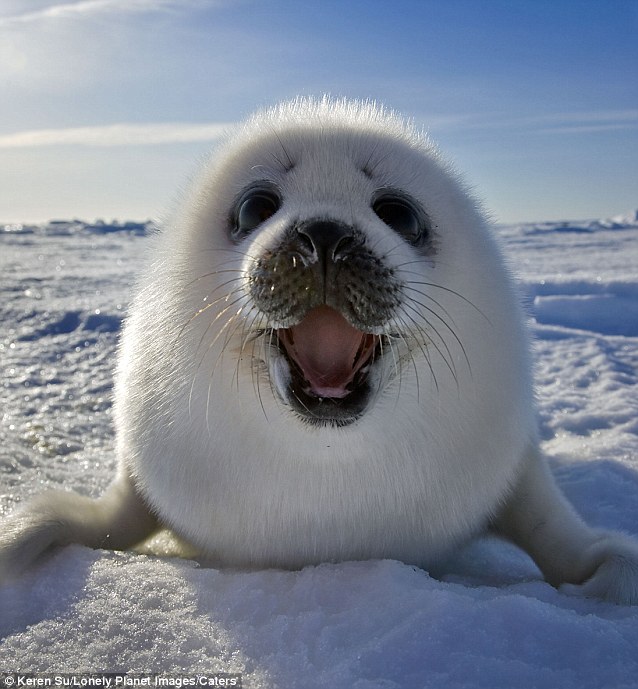
All smiles: This Harp Seal pup appears to be smiling for the camera at Iles de la Madeleine in East Canada

Why wouldn't he be smiling? This Canadian Harp Seal gets to play all day in the snow and bask in the sunshine. Life for this little guy looks pretty sweet.
And he is not alone in enjoying life in the frozen far-flung corners of our planet.
He is also a little star as he poses wildlife photographer Keren Su in this remarkable snap. Keren shot the enchanting images in the remote Iles de la Madeleine in Eastern Canada. He had to travel by helicopter to the distant area and cross the ice to the seals by crawling on his stomach.
With unpredictable weather and not to mention working with animals the 60-year-old showed incredible patience to capture the seal pup at play.

Go on, tickle my tummy: This Harp Seal rolls over in the Eastern Canada snowy wastelands, he almost looks like he is asking for a belly rub

The lensman has travelled the globe dedicating years to perfecting the ideal picture.
And his most recent work also includes the marvellous Emperor penguin in its natural habitat of Antarctica.
Keren, who lives in Seattle, USA, has even cycled across his native China taking pictures using home-made equipment.

Time for a little nap: Puffed up and sleepy this pup catches forty winks in the Canadian winter sun

During his 24 years as a professional photographer he has compiled an impressive collection of captivating images.
But the father-of-one admitted he felt most at home in freezing temperatures coming face-to-face with the wintry wildlife.
Keren said: 'I love taking pictures in the snow just for the thrill of it. I went to the remote Iles de la Madeleine in East Canada to photograph the Harp Seals but I had to be patient because it's only accessible by helicopter and the weather was unpredictable.

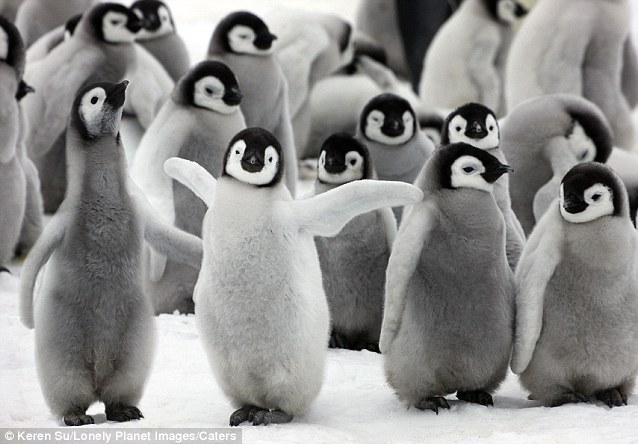
It's all about ME! A young Emperor Penguin takes his cue centre stage from the camera on Show Hill Island in Antartica

'I was only allowed a limited time with the seals and in order to get the pictures I wanted I had to crawl on the ice so the pups wouldn't be afraid of a huge stranger.
'After they had gotten used to my smell I could get closer and closer until my camera was right in front of them.
'When they became relaxed they would behave in the cutest ways imaginable.

How did you lot get up there? A penguin struggles to get up onto the ice at Snow Hill Island in Antarctica

'They are only white for a small window of ten days but they are lovely with huge black eyes and fuzzy white hair.
'They are beautiful doll-like animals. They looked directly at me and I could practically see the question mark above their heads.
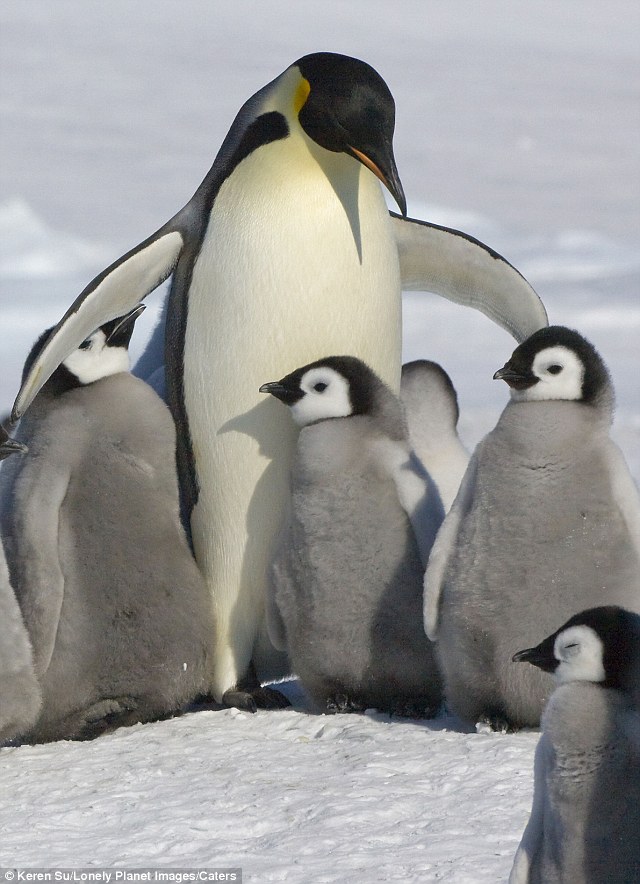
'I went to Snow Hill Island in Antarctica to photograph the Emperor Penguins and I spent a lot of time crawling on the snowy ice so that I could see the little penguins face to face.

I'll keep you warm: A penguin keeps her young close in the frozen wastes of Antarctica

'Winter is my favourite season, it's a romantic and poetic time to photograph animals.'
The Emperor Penguin is the tallest and heaviest of all living penguin species. Like all penguins it is flightless, with a streamlined body, and wings stiffened and flattened into flippers for a marine habitat.

source: dailymail

Wednesday, December 14, 2011

Love in a cold climate: Romantic penguins 'hold hands' to melt the iciest of hearts

By DAILY MAIL REPORTER


Just the two of us: This romantic pair of penguins hold hands as their buddies congregate in the distance in Port Lockroy, a natural harbour in the Antarctic Peninsula


It might be chilly outside, but this snowy snap of a penguin couple holding hands is enough to melt even the coldest of hearts.

The perfect pair enjoyed a romantic clinch, opting for a moment of solitude while dozens of other penguins gathered nearby.

The heart-warming display of affection took place in Port Lockroy, a natural harbour in the Antarctic Peninsula. It was captured on camera by professional photographer Silviu Ghetie.


The pair stand hand in hand appearing to stare out at the dramatic vista of the frozen Antarctic landscape. Their heads tilted slightly toward one-and-other, they look as if they are feeling the quiet drama that love brings to inner life.

There they stay until their penguin pal wanders along, breaking the reverie. Then, still holding each other, they wander down to the icy waters and the rest of their friends.

Photographer Mr Ghetie, 43, from Baia Mare in Romania, usually takes pictures of people but he couldn't resist snapping this magic moment while on a polar expedition.


'What are you two up to? Oh, holding hands again': Lonely heart approaches the couple and seeing they are only interested in themselves, moves switfly on


He said: 'This is the first wildlife picture I have ever taken but it's actually very apt because it just goes to show you can find the same patterns in both nature and people.

'I started taking pictures primarily because I was amazed by the landscape. The light and the atmosphere was really interesting.

'Then as I walked forward the two penguins came into view.

'I always think penguins look very much like humans from behind anyway but this was particularly funny because they really did appear to be holding hands.


source: dailymail

Thursday, December 8, 2011

We're FREE! P-p-pitter-patter of happy feet as penguins rescued from oil spill are released back into the sea

By GAVIN ALLEN


Happy feet: These excited birds were among 49 Little Blue Penguins that were released back into the wild after months in captivity following an oil spill


Waddling as fast as their little legs can carry them, these excited penguins have good reason to be happy.

Their delighted flight towards the sealine on Mount Maunganui beach in Tauranga, New Zealand, follows almost two months in humane captivity.

When the hatches to their yellow and blue transport cases were opened by a mixture of wildlife workers and schoolchildren, some of the the 49 Little Blue Penguins peeked out carefully before emerging onto the sand.


Out of the box: The penguins were released onto the beach at Mount Maunganui in Tauranga by a mixture of schoolchildren and wildlife rescue experts


Helping hand: This Little Blue Penguin is encouraged by a wild life worker to head back to the sea after almost two months in captivity


With a mixture of confusion and excitement some ran in the wrong direction, others sought out their 'friends' and flapped around in circles before heading for the water, where they bobbed about in the surf.

They were the first group to be returned to the sea as part of a staged release programme over a period of weeks.

Wildlife officials nursed some 343 of the penguins back to health after they were effectively tarred and feathered when a cargo ship ran aground on a reef near Tauranga in early October, covering them in oil.

The 775ft-long vessel called the Rena became stranded on the rocks and its torn hull released some 400 tons of fuel into the ocean.


Ready, steady, go: Despite their obvious delight at being released back into the wild, some of the birds appeared momentarily confused as they emerged from their transport boxes


On the run: These penguins were among 343 that were saved following the oil spill by the Rena that claimed the lives of more than 2,000 sea birds


Studied: The penguins have all been microchipped so their movements can be monitored after their release into the wild


Oil spill: Cargo ship the Rena became responsible for the worst environmental disaster in New Zealand's history, sending some 400 tons of fuel into the ocean


It was New Zealand's worst sea pollution disaster and it killed more than 2,000 sea birds.

But these penguins were the lucky ones and, though they were a little weaker for their time being cleaned and pampered by the wildlife rescue staff, they were always destined to return to the ocean.

Wildlife Response Manager Kerri Morgan said that it is important wild penguins do not remain in captivity for too long because they can develop injuries and illnesses.

She said: 'It's been a little bit nerve-wracking and a long process to get here.'

The penguins were fitted with microchips so they can be monitored after their release.


source :dailymail

Sunday, November 6, 2011

A right pair of love birds: Are Buddy and Pedro the African penguins more than just friends?

By LYDIA WARREN


Inseparable: African male penguins Pedro and Buddy share a hug in their enclosure at Toronto Zoo. They have displayed examples of mating behaviour


They are often seen touching each other and leave together every night.

Now the bromance between Buddy and Pedro has got keepers at Toronto Zoo in a flap about whether or not the two African penguins are gay.

Keepers have noticed the duo are showing signs of mating behaviour, including braying and defending their territory.

But the relationship is not destined to last as the zoo intends to break them up.

As African penguins are endangered, the zoo must follow its species survival plan and pair them with females for breeding.

Buddy, 20, and Pedro, 10, are part of the African penguin exhibit that opened at the zoo in May.


Good mates: The penguins, who both moved to Toronto from Toledo, Ohio in May, preen each other. They also defend their territory and perform mating calls


But the relationship is not destined to last as the zoo intends to break them up.

As African penguins are endangered, the zoo must follow its species survival plan and pair them with females for breeding.

Buddy, 20, and Pedro, 10, are part of the African penguin exhibit that opened at the zoo in May.


But every night Buddy and Pedro pair off together.

'They do courtship and mating behaviours that females and males would do,' one keeper told the Toronto Star.

As a mating call, the penguins make a braying sound, like a donkey. They defend their territory, preen each other and stand alone together.

The keepers, who are aware of the bond, were surprised by the relationship.

'This is all new for us,' another keeper told the Star.

Joe Torzsok, chair of the Toronto zoo board, added: 'It’s a complicated issue, but they seem to be in a loving relationship of some sort.'


Flying solo: Keepers plan on separating the duo, who swim with the zoo's 10 other penguins in their enclosure (pictured) each day, to mate with females


Buddy and Pedro are not the first gay penguin couple to grace the world’s zoos.

As part of an experiment in 2009, two male chinstrap penguins at New York’s Central Park Zoo, incubated an egg together and raised the chick, named Tango, after she hatched.

A children’s book, entitled 'And Tango Makes Three', about the chick and her parents, Roy and Silo, became a bestseller.

Zoos in Japan, Germany and Sea World Orlando have also noted 'pair bonding' among penguins.


More than feathered friends: Research from the University of California, Berkeley has found that birds can form same-sex relationships for life


Buddy and Pedro’s relationship follows research from the University of California, Berkeley in April, which found birds can form gay relationships for life.

Scientists found that when raised in same-sex groups, more than half the birds paired up together.

When females were then brought into the male group, five out of eight pairs of males ignored them and stuck with their male partner.

Lead author Dr Julie Elie said: 'Relationships in animals can be more complicated than just a male and a female who meet and reproduce.

'My observations led me to this surprising result: same-sex individuals would also interact like male-female pairs.'

Other species of animals exhibit homosexual tendencies. Giraffes, dolphins and monkeys are known to form same-sex bonds.


source: dailymail

Wednesday, October 5, 2011

Did someone say they'd lost a penguin? 200,000 young birds search for their hungry chicks

By JESSICA SATHERLEY

Each year, the king penguin colony at Salisbury Plains, South Georgia, produces an astonishing 50,000 chicks - a number which is on the rise

Most parents will know the problem. Your back is turned for two seconds and your little one has disappeared into the crowd.

Well just be thankful it’s not a crowd like this.

This sea of black, white and brown is created by 200,000 king penguins searching for their hungry chicks on the South Atlantic island of South Georgia.


This sea of black, white and brown is created by 200,000 king penguins searching for their hungry chicks on the South Atlantic island

And, incredibly given the apparent chaos, the young birds hardly ever get lost – thanks to each having a unique begging call.

The scene was captured by German photographer Michael Poliza after the penguins had returned en masse to their home colony for a new breeding season.


It looks like they're playing Wheres Wally: The chaotic scenes make it look impossible for the adult penguins to find their young, but because of their unique begging call amazingly they never get lost

King penguins are 3ft tall and weigh up to 33lbs. They lay just one egg each year and the fluffy brown chicks take 11 months to become self-sufficient, so it’s fortunate for them that their parents can p-p-p-pick them out.

Each year, the king penguin colony at Salisbury Plains, South Georgia, produces an astonishing 50,000 chicks - a number which is on the rise.

And Mr Poliza, from Hamburg, Germany, was left speechless when he was met by the noise, smell and breathtaking sight of the enormous colony.


Photographer Michael Poliza, who has a new exhibition opening in Germany at the end of October, had to travel to the Antarctic Peninsula on a cruise ship to capture the striking shots

"During the October courtship period, males parade the females with loud calls, an erect posture and a courtship walk - being the tallest certainly impresses the females.

"It seems like a chaotic mixture of adults and their chicks, and king penguins look quite comical, but they know exactly what they are doing.

"On land, penguins are very curious as there have been no land predators in Antarctica so I was able to get up close to them.

"I would love to go back again as it was a truly fantastic experience."

source: dailymail

Thursday, September 22, 2011

Happily feather after: The hairless baby penguin rejected by its parents who grew a new coat

By NICK ENOCH

'Left on the icy ground to die': Born without feathers and rejected by his parents, this baby penguin faced a bleak future

This dejected little chap didn't have a lot going for him.

Born without feathers and rejected by his parents, his chances of survival looked grim.

But now, thanks to the efforts of keepers at an aquarium in China's Liaoning Province, the five-day-old has been reunited with his family.


Workers at the aquarium decided that the baby penguin's lack of hair and weak condition was due to difficulties digesting food and absorbing nutrition

The little penguin was born last month - and was instantly ill-treated by its parents.

One of the zookeepers said: 'Its parents kicked it out from time to time, or even left it on the icy ground to let it die.'

Workers at the aquarium decided that the baby penguin's lack of hair and weak condition was due to difficulties digesting food and absorbing nutrition.


Thanks to the efforts of keepers at an aquarium in China's Liaoning Province, the five-day old has been reunited with his family - and grown a new coat

Spokeswoman Wang Dan said: 'In the beginning, we tried to send it back to its parents, hoping they would still take care of it and help it grow stronger.

'But they neglected it and even kicked it out.

'It was then that we decided to feed it by ourselves.'

he aquarium set up a penguin group to care for the youngster around the clock.
After a month of hand-feeding, the little penguin was much stronger.

And, much to the delight of keepers, it even grew hair.
It was then successfully re-introduced to its family group.

source: dailymail

Monday, September 5, 2011

P-p-p-push a penguin: Lost Happy Feet needs a helping hand as he returns home after life saving surgery

By Richard Shears

More familiar environment: Happy Feet is released in Antarctica from his big blue crate was four people try and encourage him to go down a specially-made slide and into the water


A lost emperor penguin named Happy Feet who turned up on a beach in New Zealand has been taken home after under-going life-saving surgery.

The 3ft bird, who was left desperately ill after eating sand that he thought was snow, was taken back to the Antarctic on a research ship.

He was released down a slide into the water two months after he was discovered disorientated more than 1,000 miles from home.


Back home: Happy Feet prepares to be sent back into the sea two months after he was discovered in New Zealand


But although he has been released, the penguin has been fitted with a tracking device so web users can keep track of where he goes over the next few months.

Vet Lisa Argilla, who looked after Happy Feet at Wellington Zoo, said she was pleased that he had been released back into the Southern Ocean.

She said: 'He slid down his specially-designed penguin slide backwards, but once he hit the water he spared no time in diving off away from the boat and all those "aliens" who have been looking after him for so long.'

F-f-f-f-Freezing: Happy Feet, who was found on a beach, prepares to go back into the sea for the first time in two months


Happy Feet, named after the 2006 film, was taken to the zoo after becoming sick on sand. He had also begun eating sticks and stones.

When he was finally taken to the zoo it was found his stomach was filled with beach debris and he had to undergo several operations to clear his system. Then he was kept in a special ice-filled quarters to copy the environment emperor penguins live in.


In he goes: The three foot tall emperor penguin slowly moves towards the water in Antarctica

Gone: Happy Feet disappears for good. Web users will be able to track his progress online as he has been fitted with a GPS tracker


Finally given a clean bill of health, he was placed in a specially-designed crate filled with ice and loaded onto the research vessel Tangaroa.

Almost a week after leaving New Zealand, vets on board the ship decided today they had taken Happy Feet far enough south for him to be able to make his way onwards to the Antarctic.


Where he was found: The washed up emperor penguin walks along Peka Peka Beach in New Zealand - 3,000 miles north of its home in Antarctica


Sea conditions were too rough for Happy Feet to be released by hand, so he was placed on a tarpaulin slide running from the boat's ramp.

'He needed some gentle encouragement to leave his crate, but then the release went really well,' said Miss Argilla.


Where he should be: Emperor penguins walk over the ice in Antarctica


A team from the National Institute of Water and Atmospheric Research and the boat crew were all on deck to wave him goodbye.

'It's an indescribable feeling to see a patient finally set free,' said Miss Argilla.

Voyage leader Richard O'Driscoll told Wellington's The Press newspaper that apart from giving the veterinary team a few nips at feeding time, the penguin had been a well-behaved passenger.


Life-saving: A team of medics operate on the penguin - named Happy Feet - who ended up 3,000 miles away from home and became sick after eating sand it mistook for snow. He was found on June 20


'It's been a pleasure to have Happy Feet on board,' he said. 'We're just happy to help him on his journey home.'

But just in case he gets lost again, the wayward penguin has been fitted with a tracking device, which will eventually drop off, so the team - and the public - can follow his progress back home.


source:dailymail

Monday, August 29, 2011

The emperor penguin named 'Happy Feet'


In this Aug. 28, 2011 photo released by China's Xinhua News Agency, emperor penguin "Happy Feet" is seen in his room at Wellington Zoo's hospital, New Zealand. The emperor penguin has been booked onto a research vessel scheduled to leave the country Aug. 29.


The penguin was found at Peka Peka beach on the Kapiti Coast in June with concerns for his health. Wellington Zoo intervened and nursed the penguin back to good health. He will be released into the Southern Ocean,


WELLINGTON, NEW ZEALAND - AUGUST 29: The emperor penguin named 'Happy Feet' sits in his container aboard NIWA's research vessel Tangaroa, at Burnham Wharf on August 29, 2011 in Wellington, New Zealand.


WELLINGTON, NEW ZEALAND - AUGUST 29: Gareth Morgan, who helped fund the electronic tracking equipment for the emperor penguin 'Happy Feet', holds a giant farewell card containing messages from around the world, beside NIWA's research vessel Tangaroa, at Burnham Wharf on August 29, 2011 in Wellington, New Zealand.


The penguin was found at Peka Peka beach on the Kapiti Coast in June with concerns for his health. Wellington Zoo intervened and nursed the penguin back to good health. He will be released into the Southern Ocean


The penguin was found at Peka Peka beach on the Kapiti Coast in June with concerns for his health. Wellington Zoo intervened and nursed the penguin back to good health. He will be released into the Southern Ocean


WELLINGTON, NEW ZEALAND - AUGUST 29: The emperor penguin named 'Happy Feet' is transported to NIWA's research vessel Tangaroa, at Burnham Wharf on August 29, 2011 in Wellington, New Zealand.


WELLINGTON, NEW ZEALAND - AUGUST 29: The emperor penguin named 'Happy Feet' stands in his container aboard NIWA's research vessel Tangaroa, at Burnham Wharf on August 29, 2011 in Wellington, New Zealand. The penguin was found at Peka Peka beach on the Kapiti Coast in June with concerns for his health. Wellington Zoo intervened and nursed the penguin back to good health. He will be released into the Southern Ocean, complete with GPS tracking device, from NIWA's research vessel four days into a month-long trip to the Campbell Islands, 700km south of New Zealand.


source: daylife
photo: Getty images

Tuesday, August 9, 2011

Sand sculptures used by sea park to combat the loneliness of its penguins

By HUGO GYE

Blending in: The penguins at the Sea Life Park in Weymouth are delighted by their new neighbours

Penguins may not be used to sand - after all, the icy conditions of the Antarctic are very far from sunny beaches.

But this group is feeling right at home now that they have been given company in the form of sand-sculptures of their fellow penguins.

The sculptures were created by an artist in order to console the birds after the departure of another group to whom they had become attached.


Cheering up: The Humboldts had been pining for their Gentoo pals but seem satisfied with the artificial replacements


And the 11 Humboldt penguins who live at the Sea Life Park in Weymouth, Dorset, are now entertaining visitors by trying to befriend the fake birds.

The penguins had been joined temporarily by a group of Gentoo penguins earlier this year while they were in transit.


Curious: The penguins have been seen trying to befriend the new additions to their enclosure

The Gentoos, which are larger and more energetic than the laid-back Humboldts, spent a couple of months in the park and got on well with their hosts.

But when they were moved on to their new home, at a special exhibition at the Sea Life London Aquarium, the Humboldts were left pining for the charismatic birds.

source :dailymail

Twitter Delicious Facebook Digg Stumbleupon Favorites More

 
Design by Free WordPress Themes | Bloggerized by Lasantha - Premium Blogger Themes | Grants For Single Moms