Showing posts with label Animals. Show all posts

Thursday, January 12, 2012

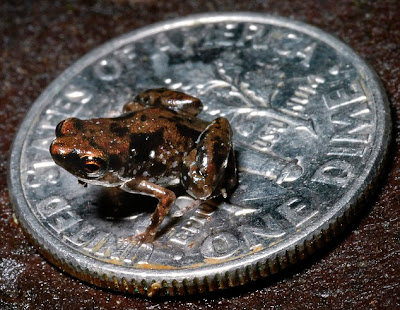
Smallest vertebrate in the world found in Papua New Guinea: Frog measures just 7mm

By TAMARA COHEN

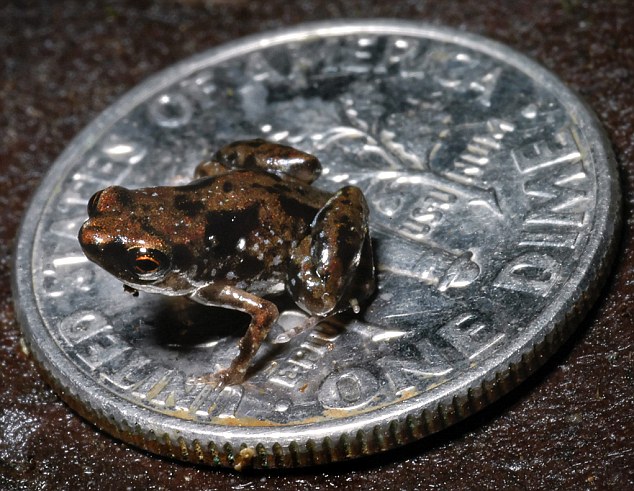
Miniscule: This tiny frog, believed to be the smallest vertebrate on Earth, has been discovered by scientists in Papua New Guinea

Perched on a coin the size of a 5p piece, there is still probably room for two.
At half the size of a Smartie sweet, this is the world’s smallest frog, measuring just a quarter of an inch long.
Scientists discovered the previously unknown creature, speckled in red and black, sitting on a leaf on the tropical island of Papua New Guinea.
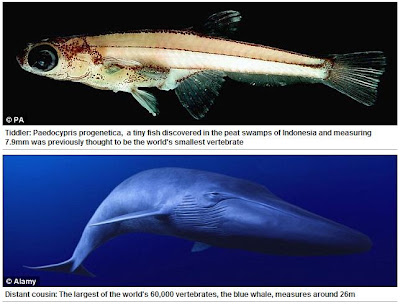
At just 7.7mm in size when fully grown, it has snatched the title as the smallest of the world’s 60,000 vertebrates – creatures with a backbone – previously held by a tiny Indonesian fish which measures 7.9mm.
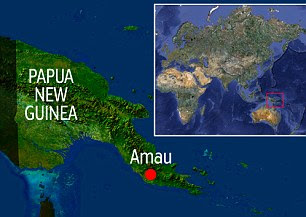
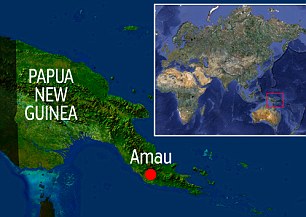
The tiny creature was discovered in Amau, Papua New Guinea

Experts are baffled by the find as it was previously thought extreme body size in vertebrates, whether large or small, was associated with living in water.
Professor Chris Austin, of Louisiana State University, who discovered the frog on a three-month field trip to the Pacific island, said by contrast these creatures make their habitats on fallen leaves on the floor of tropical rainforests.
His discovery of the creatures, named Paedophryne amanuensis after a village called Amau near where they were found, will help scientists understand more about extreme body size, he wrote in the journal PLoS One. They are thought to have evolved ‘extreme miniaturisation’ to fill a hole in the food chain which was not being exploited by others, perhaps to eat minuscule creatures such as mites which would not sustain larger frogs.

It was no easy job to find one, but his team followed the high-pitched calls made by adult males when they are looking for a mate.
The tiny specimen fits comfortably on a US dime, which measures 17.9mm, slightly smaller the size of a 5p piece which measures 18mm.
Prof Austin said: ‘We now believe they aren’t just biological oddities, but instead represent a previously undocumented ecological guild - they occupy a habitat niche that no other vertebrate does. ‘It was particularly difficult to locate Paedophryne amauensis due to its diminutive size and the males’ high pitched insect-like mating call. ‘But it’s a great find.
New Guinea is a hotspot of biodiversity, and everything new we discover there adds another layer to our overall understanding of how biodiversity is generated and maintained.’

source: dailymail
How many endangered animals can you spot in the World Wildlife Fund’s poster warning about deforestation?

By NADIA GILANI

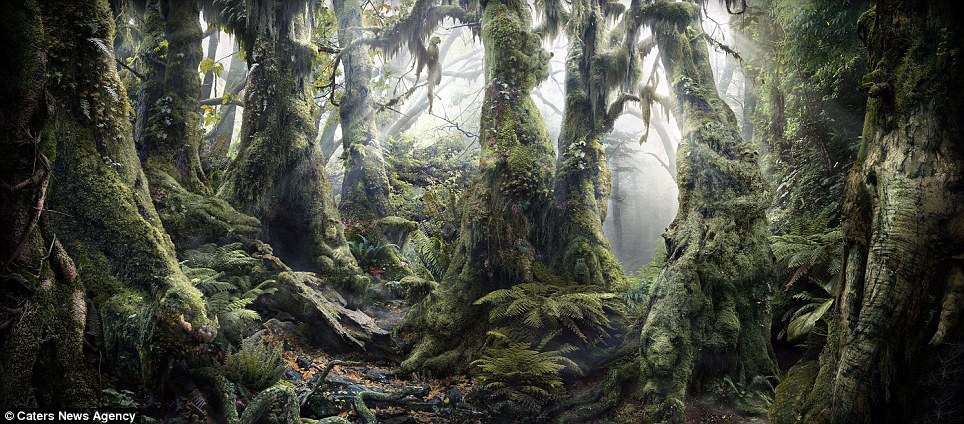
Hidden depths: At first glance this looks like a picturesque image of a leafy rainforest

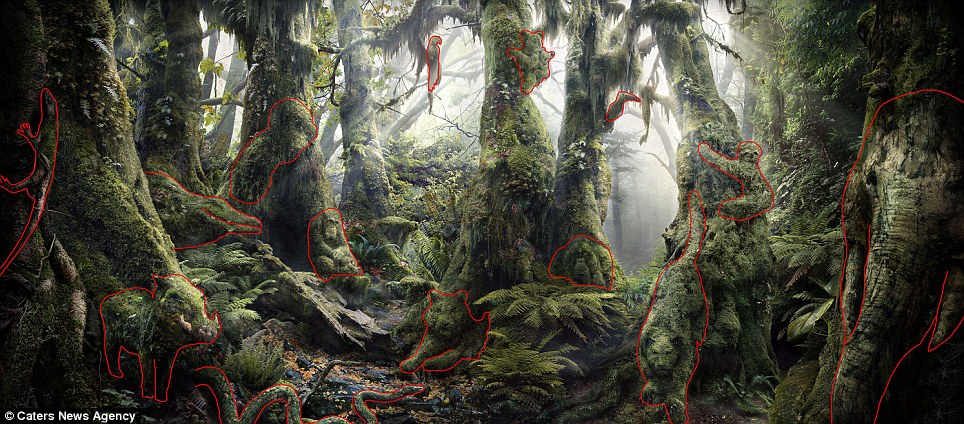
Now you see them, now you don't - a striking portrayal of animals hidden in a rain forest which could all be wiped out as a result of deforestation are revealed in a poignant poster. The poster from wildlife campaigners WWF shows everything from a lion to an elephant which have all been skilfully concealed in a jungle vista.
The animals are camouflaged as if they are part of the tropical and lush undergrowth, but in fact what appears to be a tree trunk or vine is actually a lot more.

Endangered: The camouflaged animals can be seen marked with a red outline revealing those most affected by deforestation

The poster - part of campaign to highlight the damage of deforestation - was aimed at getting the public to take a moment to consider how many animals could be lost if deforestation continues at it's current rate.
Forests still cover around 30 percent of the world's land surface but they are being felled at a rate of nearly 30 square miles a year - roughly an area the size of Panama.

During the past 40 years, close to 20 percent of the Amazon rain forest has been cut down more than in all the previous 450 years since European colonisation began
This poster was plastered along busy stretches of the Paris Metro underground and featured in Lonely Planet magazine. Marine Garcia, from design agency Marcel, said four artists worked meticulously on the poster to try and conceal the animals from the public
just enough to make them work to see them.
She said: 'The point of this poster was to let people know that deforestation does not only kill trees, it is also killing wildlife too.
'The animals are hidden because soon we might really not be able to see them again.'

source: dailymail

Thursday, January 5, 2012

The big count begins! Keepers at London Zoo start annual stock-take of 18,500 animals

By EMILY ALLEN

Sit still, I'm trying to count! Keeper Adrian Walls conducts the annual stocktake at London Zoo, which has more than 18,000 animals

They can dive, swim and glide but even the penguins at London Zoo will find it difficult to hide from keepers who have the tricky but essential task of counting every animal in their care.
Some of the world's most endangered species, including rare penguin breeds and two new lion cubs, will be counted for the first time in this year's stock-take.
Macaroni, blackfooted and rockhopper penguins will be among those totted up in their new 1,200 square metre home - the largest penguin pool in the country - along with 752 different species at the zoo.

Camel, 1: A Bactrian camel spits in a zookeepers face during a photocall to promote London Zoo's annual stock take of animals

Adrian Walls, team leader of birds at ZSL London Zoo, said: 'We built a very naturalistic environment for the penguins so they can come and go and swim around.
'We work with these birds every day so we know their characteristics and we get to know most of them individually.
'The count does take some time but the penguins have their own individual tags so we can tick them off when we see them.'


Spider, 2: A Red-Kneed Spider rests on a zookeeper's hand as a zoo keeper logs its details during the stocktake

Stocktake: London zookeeper Adrian Walls poses for a photograph as he counts the penguins watched by the nation's media

Once the final figures are collected the data can be shared with zoos worldwide and can be used to help breeding programmes.
Mr Walls added: 'Generally speaking we don't ever lose any animals. We monitor them on a daily basis to make sure every animal is happy and healthy.'
Armed with clipboards and abacuses, the zookeepers recorded 18,499 animals last year, but since then two ginger-haired Francois langur monkeys and two new lion cubs have been born.

A zookeeper feeds Squirrel monkeys. Once the final figures are collected the data can be shared with zoos worldwide and can be used to help breeding programmes

A Waxy Tree Frog rests on a zookeeper's hand while zookeeper Adrian Walls counts the penguins. The zoo's stocktake takes place every year

The female cubs, nicknamed Pumpkin and Spook, made their first appearance in their outdoor paddock in November and are beginning to play fight with each other.
There are around 350 Asian lions remaining in the wild and 90 in captivity.
The cubs are living with their mother, Abi, in the lion den and are slowly being introduced to their 28-stone father, Lucifer.

A penguin swims in its enclosure. Macaroni, blackfooted and rockhopper penguins will be among those totted up in their new 1,200 square metre home - the largest penguin pool in the country

Jungle Nymphs rest on a zookeeper's hand. The zookeepers recorded 18,499 animals last year, but since then two ginger-haired Francois langur monkeys and two new lion cubs have been born

Mark Habben, zoological manager, said: 'The lion cubs are probably the most impressive new arrivals and they are on view now which is a very exciting sight.
'The animals that are always harder to monitor are the fish in the aquarium. There is a lot of rock work so it's hard to be able to count everything.
'It can take up to several weeks for zookeepers to complete the final count in the bug house and aquarium.'
The stocktake is required as part of ZSL London Zoo's licence.

source: dailymail

Friday, December 30, 2011

The surreal wonderland of creepy-crawlies: Photographer creates fantasy world - on his kitchen table without digital trickery

By GARETH FINIGHAN

Slugs, snails and other creepy-crawlies might not be to everyone's taste, but as these photographs reveal, they can help create stunning works of art.
Photographer Nadav Bagim has created a surreal wonderland of giant toadstools, pastel skies and brightly-coloured flora in which insect characters roam.
Nadav, 30, from Ramat-Gan, Israel, took up photography three years ago and immediately became interested in shooting nature and macro landscapes.


Magical world: These out-of-this-world scenes were created in Nadav's kitchen using insects he found around his home

He finds his subject matter - spiders, crickets and other bugs - in and around his apartment, and shoots most of the scenes on a kitchen table.
Titled The Wonderland Series, Nadav, a science student, said: 'It is being composed by using a unique but rather simple and elegant artificial lighting and household objects form vegetables to plastic bags.


The slug and lettuce: Some of the surreal images created by photographer Nadav Bagim
'The photos are shot mostly in a miniature studio on my kitchen's table with a Canon EOS 60D Camera, and a Canon 100mm f/2.8 Macro lens and flashes. They are real and not a digital manipulation.
The outcome is a beautiful and magical set with a fairy flair to it.'
Nadav pointed out that none of his subjects are harmed during the photography sessions.


In the pink: This slug appears perfectly content in its florescent landscape

source: dailymail

Tuesday, December 27, 2011

Talon contest: Fawn's gripping encounter with golden eagle as it swoops in for the kill

By DAVID RICHARDS


This dramatic scene was played out during an annual eagle hunt in Slovakia and was captured by photographer Milan Krasula, 30, who spent four days trying to get a good picture of the chase where owners release their birds to go after prey


With one set of talons grasping its back the outlook wasn't good for this fawn as a golden eagle swooped in for the kill.

But a split second later the deer managed to duck out of danger as it scrambled under a fence forcing the bird of prey to rise back up into the sky.

The dramatic scene was played out during an annual eagle hunt in Slovakia and was captured by photographer Milan Krasula, 30, who spent four days trying to get a good picture of the chase where owners release their birds to go after prey.


He said: 'You have to be very lucky to get a good shot, as you cannot predict where the prey will be hiding.

'I found an area that I thought it would be good for a photo and where some smaller animals might be hiding.

'I was waiting there around an hour or so, when all of a sudden there was a young little doe running out from the forest.


source: dailymail

Monday, December 19, 2011

Are these the sickest stuffed animals ever? Now artist faces JAIL over taxidermy

By DAILY MAIL REPORTER


Mythical: The surreal sculptures feature a doubles head swan on the body of what appears to be a goat


Like a modern day Dr Frankenstein, Enrique Gomez De Molina creates hauntingly stunning hybrid sculptures made from the stuffed parts of dead animals.

But it is his beloved mythical creatures that could land the Miami artist in jail for up to five years and see him forking out $250,000 in fines.

De Molina uses the parts of once-living animals and merges them together to create strange beings, one example features the head of two swans on the body of a goat and another shows the head of a squirrel meshed with a crab.


Creepy: This otherworldly piece is created with the head of a screaming squirrel and the body of crab


Nightmarish: This taxidermy Sculpture called the McSparboe Salmonella is a mix of a rooster and a goat


The artist pleaded guilty to illegally importing parts from endangered species to make the unique pieces of art after his arrest in November, reports Miami New Times.

He smuggled in the parts, skins and remains, from whole cobras, pangolins, hornbills, and the skulls of babirusa and orangutans from areas all over the world including Bali, Indonesia, Thailand, the Philippines and China.


Hybrid creature: De Molina uses the parts of once-living animals and merges them together to create strange but striking sculptures


According to the report, he is charged with possessing the skins of a Java kingfisher, collared kingfisher, bird of paradise, and juvenile hawk-eagle as well as the carcasses of a slow loris and a mouse deer, all from Indonesia.

The artist had not obtained the required permits to import the animal parts, and police claim De Molina knew what he was doing was illegal as he asked the people he bought them from to wrap them in carbon paper, according to the MN Times.


Weird: In this strange example De Molina merges a goat's head and hooves with the body and tail of a skunk


Macabre: De Molina smuggled the parts of dead endangered species into America to make the sculptures


De Molina's work was exhibited at the Scope Art Fair, one of the leading Art Basel Miami Beach satellite fairs, with two of his controversial pieces fetching a total of $100,000

He offers his pieces through galleries and on the internet for prices ranging up to $80,000.


Controversial: De Molina offers his pieces through galleries and on the internet for prices ranging up to $80,000


Scary: The mythical creatures could land the Miami artist in jail for up to five years and see him forking out $250,000 in fines


Illegal: The artist had not obtained the required permits to import the animal parts, and police claim he knew what he was doing was illegal


The artist claims that he aimed to raise awareness with his work to the danger faced by a range of species, with his surreal pieces representing the dangers of genetic engineering and human intervention.

On a website showcasing his work he says: 'The impossibility of my creatures brings me both joy and sadness at the same time.


source: dailymail

Wednesday, December 14, 2011

Very Christmassy Mr Mayor, but why exactly is a leopard ripping the throat out of a gazelle on your Christmas cards?

By MICHAEL ZENNIE

What was he thinking? Mayor Jorge Santini and his family smile placidly for this Christmas card as a leopard mauls a gazelle

A festive riddle: What does a leopard brutally mauling a gazelle have in common with a turkey swooping over a black blear and a little lost penguin waddling over the ice?
Christmas, of course!
All three scenes, played out with stuffed animals, were the backdrops for a series of inexplicably bizarre official Christmas cards from Jorge Santini, the mayor of San Juan, Puerto Rico.

The mayor says he chose the scenes as a way to promote the San Juan Wildlife Museum and the realistic natural history displays it offers.
But some political rivals say the Christmas cards are veiled, if awkward, threats about the upcoming election next year, the Huffington Post reported.

Promotion or threat? The mayor says the cards are simply a way to promote the San Juan Wildlife Museum. Political opponents say they are veiled threats

In the three cards, the mayor, his wife and three children placidly grin for the camera, seemingly oblivious of the frozen wild animals around them.
The most incongruous of the three cards is one that features a leaping leopard grabbing a helpless gazelle by the throat.
Mayor Santini's 7-year-old daughter smiles coyly at the edge of the photo.

Election upcoming: Mayor Santini, who has led Puerto Rico's largest city since 2001, faces the voters in an election next year

'May your dream be illuminated this Christmas,' says the card - a rough English translation according to Huffington Post.
Mayor Santini, 51, has served as mayor of San Juan City - the capital of Puerto Rico - since 2001.
San Juan, with a population of nearly 400,000, is also the island's largest city.
Puerto Rico is a primarily Spanish-speaking territory of the United States located about 1,000 miles from the southern tip of Florida in the Caribbean Sea.

source: dailymail

Wednesday, December 7, 2011

Masters of disguise: The gecko that resembles a leaf and nature's other camouflage experts

By WIL LONGBOTTOM


Blending in: This Satanic Leaf-tailed Gecko hides from predators in Andasibe-Mantadia National Park, Madagascar, or is it just a leaf?

Stare at these pictures for long enough and you might just spot some clever creatures playing the ultimate game of hide and seek.
This Satanic Leaf-tailed Gecko is barely visible against the leaves in the Andasibe-Mantadia National Park, Madagascar.
These amazing animals are true masters at blending effortlessly into their environment as a means of survival in the natural world.

Nothing to see here: A Bat-faced Toad hides among dead leaves in Amacayacu National Park, Colombia

Barking up the wrong tree: It's nearly impossible to pick out this Lichen Spider at the Erawan National Park in Thailand

From frogs to fish and bugs to birds, this collection of images shows the animal kingdom's outstanding camouflage ability.
Animals use two basic methods of concealment in a bid to hide from predators and catch prey.
These are general resemblance and special resemblance.

Nothing to see here: A Speckled Sanddab blends perfectly with the pebbled ocean floor

Kicking off: This Sandhopper protects itself by covering red sand all over its body in the desert


That's a blooming good disguise: An Orchid Mantis sits inside a flower

Unbe-leaf-able: This Leaf Katydid looks like part of the forest floor in San Cipriano Reserve, Colombia

Can you spot me? A snow leopard looks for prey in the Himalayas

With general resemblance animals use colour to blend in with their background until they are almost invisible.
This method is commonly associated with chameleons but other creatures, including spiders and the Hymenopus Coronatus or Orchid Mantis, adopt this tactic when hiding and hunting.
Special resemblance sees creatures use a mixture of shape, colour, texture and behaviour to make them appear like something else in their habitat, such as a leaf or twig.

Buzz off: This Peppered Moth has found the perfect hiding place on a rock

Can you sea me yet? A Righteye Flounder camouflages himself on the ocean floor


That act's getting a bit wooden: This Mossy Leaf-tailed Gecko is a master of disguise in Montagne dAmbre National Park, Madagascar

Stop mossing around: A Katydid blends into foliage in Costa Rica

Stick with it: There's a Leaf Frog in there somewhere

Among the other images is a Sandhopper which has kicked red desert sand over its body to protect itself and a Speckled Sanddab fish which blends into the pebbled ocean floor.
A male Shale Grasshopper also mimics the stones it sits on.

It has eyes! A Vietnamese Mossy Frog is perfectly adapted to his surroundings

Where did he go? The Great Potoo hides in a tree in Brazil as it searches for food

Double act: A pair of Glass Frogs shelter in foliage at Manu National Park, Peru

source: dailymail

Twitter Delicious Facebook Digg Stumbleupon Favorites More

 
Design by Free WordPress Themes | Bloggerized by Lasantha - Premium Blogger Themes | Grants For Single Moms