Showing posts with label Seal. Show all posts

Friday, January 20, 2012

Are you my new daddy? Orphan baby seal becomes big hit with locals

By DAILY MAIL REPORTER

Firm friends: The head of S.O.S Rescate Fauna Marina, Richard Tesore, playing with the baby seal

This is a friendly little chap. And the 15-day-old male baby seal has brought delight to locals at a seaside resort in Uruguay.
The orphan, taken in by S.O.S Rescate Fauna Marina, is happy as Larry perched on the shoulders of the organisation’s head, Richard Tesore.

Just a baby: The male seal enjoys being fed milk from the bottle

He drinks milk from the bottle and takes regular trips out into the sea as he is nursed to fitness after losing contact with his mother.
And he doesn’t seem to mind at all as he poses for holidaymakers’ pictures at the resort of Piriapolis, Uruguay.

Smile for the camera: The seal has become used to regular photoshoots with locals

The rescue centre has become a popular attraction just 60 miles down the road from Montevideo and has recently cared for dolphins and baby penguins before releasing them back into the wild.
Bruce Willis lookalike Richard certainly enjoys getting to know the animals – and the affection is clearly mutual.

The seal is being nursed back to fitness after losing contact with his mother


Piggyback: The seal posing for pictures, lives near the seaside resort of Piriapolis, 56 miles east of Montevideo

source: dailymail

Friday, January 13, 2012

Meet the incredible smiling seal! How an intrepid photographer crawled across the ice on his stomach to get these amazing images

By DAILY MAIL REPORTER

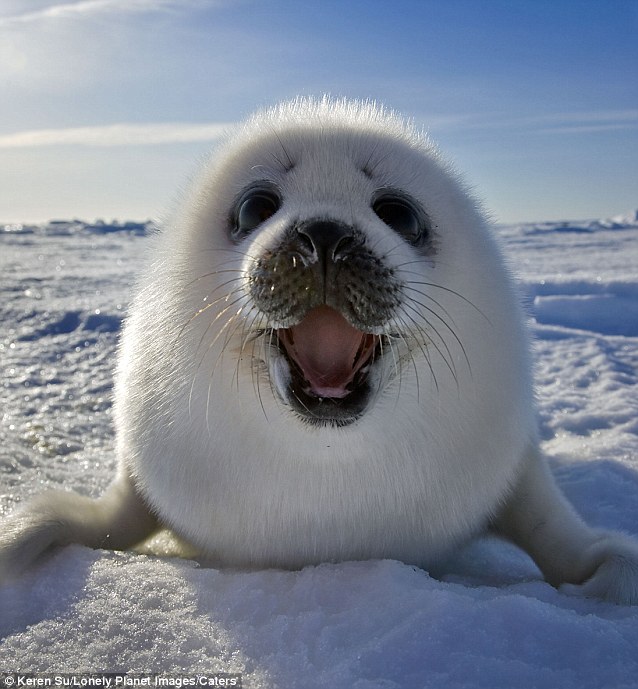
All smiles: This Harp Seal pup appears to be smiling for the camera at Iles de la Madeleine in East Canada

Why wouldn't he be smiling? This Canadian Harp Seal gets to play all day in the snow and bask in the sunshine. Life for this little guy looks pretty sweet.
And he is not alone in enjoying life in the frozen far-flung corners of our planet.
He is also a little star as he poses wildlife photographer Keren Su in this remarkable snap. Keren shot the enchanting images in the remote Iles de la Madeleine in Eastern Canada. He had to travel by helicopter to the distant area and cross the ice to the seals by crawling on his stomach.
With unpredictable weather and not to mention working with animals the 60-year-old showed incredible patience to capture the seal pup at play.

Go on, tickle my tummy: This Harp Seal rolls over in the Eastern Canada snowy wastelands, he almost looks like he is asking for a belly rub

The lensman has travelled the globe dedicating years to perfecting the ideal picture.
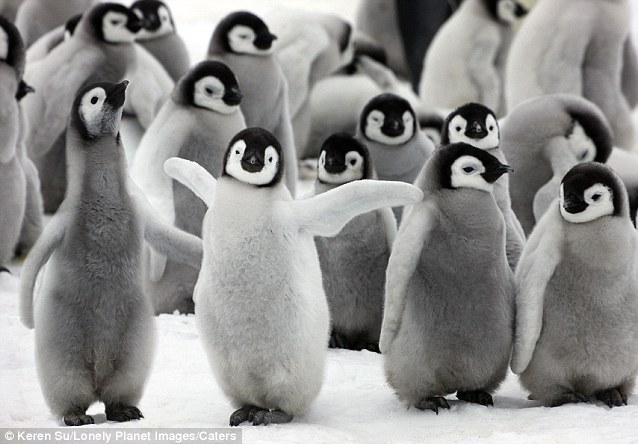
And his most recent work also includes the marvellous Emperor penguin in its natural habitat of Antarctica.
Keren, who lives in Seattle, USA, has even cycled across his native China taking pictures using home-made equipment.

Time for a little nap: Puffed up and sleepy this pup catches forty winks in the Canadian winter sun

During his 24 years as a professional photographer he has compiled an impressive collection of captivating images.
But the father-of-one admitted he felt most at home in freezing temperatures coming face-to-face with the wintry wildlife.
Keren said: 'I love taking pictures in the snow just for the thrill of it. I went to the remote Iles de la Madeleine in East Canada to photograph the Harp Seals but I had to be patient because it's only accessible by helicopter and the weather was unpredictable.

It's all about ME! A young Emperor Penguin takes his cue centre stage from the camera on Show Hill Island in Antartica

'I was only allowed a limited time with the seals and in order to get the pictures I wanted I had to crawl on the ice so the pups wouldn't be afraid of a huge stranger.
'After they had gotten used to my smell I could get closer and closer until my camera was right in front of them.
'When they became relaxed they would behave in the cutest ways imaginable.

How did you lot get up there? A penguin struggles to get up onto the ice at Snow Hill Island in Antarctica

'They are only white for a small window of ten days but they are lovely with huge black eyes and fuzzy white hair.
'They are beautiful doll-like animals. They looked directly at me and I could practically see the question mark above their heads.
'I went to Snow Hill Island in Antarctica to photograph the Emperor Penguins and I spent a lot of time crawling on the snowy ice so that I could see the little penguins face to face.

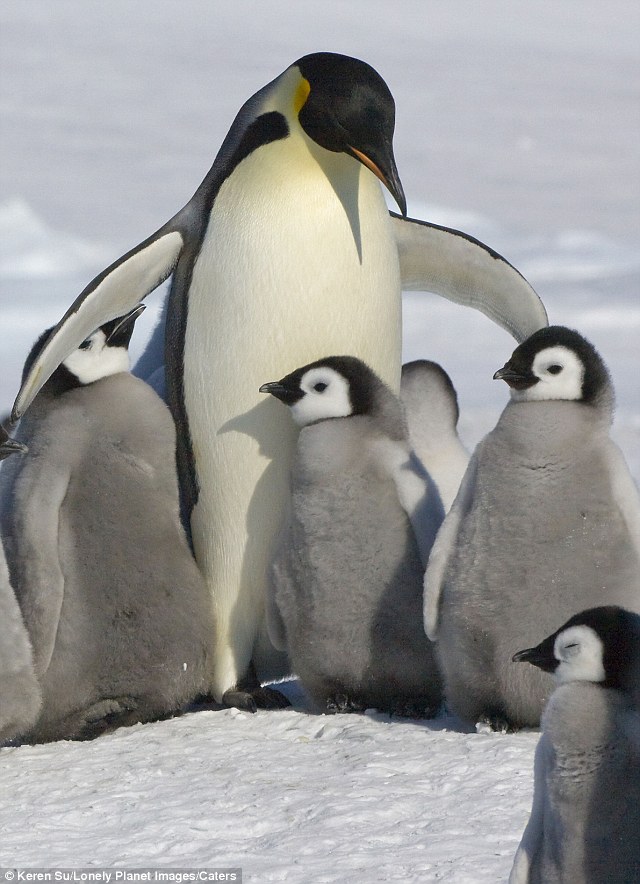
I'll keep you warm: A penguin keeps her young close in the frozen wastes of Antarctica

'Winter is my favourite season, it's a romantic and poetic time to photograph animals.'
The Emperor Penguin is the tallest and heaviest of all living penguin species. Like all penguins it is flightless, with a streamlined body, and wings stiffened and flattened into flippers for a marine habitat.

source: dailymail

Friday, December 30, 2011

I'm having you ... for lunch: Awesome display of shark's power as it closes in on seal

By MARY MCCONNELL

Awesome power: The seal fails to escape from the great white shark off the coast of South Africa

In a breathtaking display of power and agility a seal tries to escape from the jaws of a great white shark seconds before it becomes lunch.
Travelling through the water at an incredible speed the tiny cape fur seal is dwarfed by the enormous shark, which is hunting off the coast of Cape Town, South Africa.
The incredible series of images show the constant struggle for survival for the animals that live on Seal Island in False Bay where around 12,000 seal pups are born each November and December.

Ocean battle: The great white shark attempts to grab the seal

Taken over three years by wildlife photographer David Jenkins, these pictures illustrate exactly why great whites are considered one of the world's most precision predators.
David, 39, said: 'I have travelled around many places in the world but this was the most incredible thing I had ever seen - it has to be seen to be believed. It's an awesome display of power and agility. When a shark suddenly explodes out of the water and you see it close up through the lens you get one hell of a shock.'

Lunchtime: The seal fails to escape from the jaws of the great white shark

'At the height of the season there can be between 30 to 50 sharks in the area, although you will be lucky to see more than five,' he added. 'Their hunting success rate is very high - almost 50.
'But the shark is up out of the water and back in less than a second, look the wrong way or blink and all you will see is a splash.'
Freelance photographer David, who also works for the African Lion and Environmental Research Trust in Zimbabwe, first witnessed the sharks breaching in 2009 and quickly became enthralled.

Jaws: This tiny cape fur seal tries to avoid becoming lunch for this great white shark

Shark attack: The seal makes a last ditch attempt to avoid being killed by the great white

Since then he has returned to the same spot year after year studying the interplay between predator and prey.
He said: 'If the shark manages to get the seal straight away then you are just stunned at how quickly it can happen and the power and speed and athletic ability of the shark.
'However, like any other life and death battle in the wild, if the shark misses on the first strike and the interaction between predator and prey can be observed, it is hard not to start cheering for the seal.'

The jaws of defeat: The shark finally gets its kill

source: dailymail

Saturday, November 26, 2011

Loneliest seal in the world, shunned by her colony for being ginger, is now the centre of attention at Russian zoo... and loving it

By WILL STEWART


Star attraction: Happy in her new home at the Akvatoria 'dolphinarium' in Russia, ginger seal Nafanya is quickly becoming a hit with tourists


Things are looking up for the little ginger-coloured seal pup whose fate touched the world after being rejected by the rest of its sleek black family.

Left as an outcast, the vulnerable creature was found huddling under a pile of logs on Tyuleniy Island in the far east of Russia.

Photographer Anatoly Strakhov, 61, took heartbreaking pictures of the world's loneliest seal, which would have been unable to survive in the wild.


Heartbreaker: Anatoly Strakhov's shot of the shunned seal melted the hearts of animal lovers worldwide


Two months on and Russians have taken the rare albino seal - who turns out to be female - to their hearts.

Named Nafanya - after a lookalike Soviet cartoon character - the seal was given VIP treatment and has now moved into a plush new home at the country's leading aqauarium.

Nafanya was taken on a 7,890-mile odyssey to the Russian mainland and then by special plane to Adler, near Sochi on the Black Sea coast, where she is rapidly becoming a star attraction.


Yulia Frolova, head of the Akvatoria dolphinarium - Nafanya's new home, said: 'She now has a special enclosure with a pool, and two weeks after her arrival, people are already coming to see her.

And, quickly adapting to life among humans, the seal has her own live webcam so her worldwide fans can follow her - http://www.nafanya-sochi.ru/ - which broadcasts between 7am and 1pm UK time.

Miss Frolova said: 'She has a good appetite, and always seems in a happy mood. She is such an unusual seal with very beautiful bright blue eyes. When she arrived, she was tired after the long flight, but soon picked up her appetite.'


What's in a name? The seal bears a striking resemblance to Nafanya, a Soviet-era cartoon character


Experts at the dolphinarium say Nafanya's eyesight is not as poor as at first feared. Originally thought to be almost blind, it turns out she only has trouble seeing in bright sunlight. And, given her celebrity status, some dark sunglasses may not be a bad idea.

Her keepers say she loves being the centre of attention, and Ms Frolova added: 'She has a playful nature. She loves to play with her toy - a small blue ball.

'But what she likes the most its to play with a fish at feeding time. She will follow it, catch it, put it in her mouth, release it and finally eat it.


Still lonely: Nafanya can't shrug off the title as 'loneliest seal in the world' yet, as she has to be kept in quarantine for a month before joining other seals at the aquarium


source: dailymail

Friday, November 25, 2011

Flipping 'eck, that's what you call sealing love with a kiss: Touching interaction of mothers and pups at wildlife nursery for 1,000 births

By DAVID DERBYSHIRE


A mother's love: A happy seal reaches out to pull her newborn cub closer. She was pregnant for a year before giving birth


A mother’s loving hug is all a young pup needs. These gloriously endearing images are from one of the greatest spectacles of British wildlife — the seaside nursery on the Lincolnshire coast where 1,000 seal pups are born and weaned each autumn.

At first the seals look like sunbathers, scattered in their thousands across the wide beach, framed by the North Sea and banks of rolling dunes.

Get up close though, and you will see an almost human interaction between mother and pup at Donna Nook, a nature reserve north of Skegness, where hundreds of grey seals descend every year.


Stay close: A safe snuggle under mum's flipper. But soon she will be off to sea and the pup will have to fend for itself


While the beach is remote — it is reached via a single-track lane —– thousands of nature lovers come to watch the pups at close range, separated from them only by a fragile wooden fence.

Rachael Shaw, of Lincolnshire Wildlife Trust, said: ‘It’s like everything you can see on the best wildlife TV programmes but it’s right in front of you. Some people see pups being born. You see the males fighting. There are very few opportunities to see large wild animals like this.’

The grey seal colony is the largest and most accessible on mainland England. Numbers have increased in the past few decades, from around 200 seals in the 1960s. Last week wildlife experts recorded 880 pups, 975 females and 331 males on the beach.


The tender touch: A cub keeps its soft white fur for just a few weeks while it is being weaned on the Lincolnshire beach


Females are pregnant for a year — and are able to mate soon after giving birth — which makes for a busy few weeks. The first adults arrive on the beach at the end of October. The females have just one pup and suckle them for three weeks.

Once the pup — they lose their soft white fur within a couple of weeks — is weaned it is abandoned by the mother who mates again and then heads off to sea. The pup stays on the beach, but is driven by hunger to find fish. Most of the seals have gone by Christmas.


Motherly love: The grey seal colony is the largest and most accessible on mainland England


The biggest threat comes from spectators. At weekends the narrow strip of sand where visitors can stand is packed. Last year 60,000 people came.

Miss Shaw says: ‘We would prefer people to come on weekdays if they can, or to wait until mid December when it is quieter. And people should never get too close or touch a pup. A mother may abandon a cub if it smells of humans or dogs.’


Life's a beach: Visitors enjoy the amazing spectacle of seals basking at Donna Nook


source: dailymail

Thursday, September 8, 2011

How about a flipping lift then? Hitch-hiking seal wriggles onto country road miles from sea

By Daniel Miller

Wrong turn: A fur seal was discovered crawling onto a road in the Australian outback miles from sea

This lost seal was in desperate need of a lift home after ending up stranded on a back road in the Australian outback miles from the ocean.

Motorists gathered round as the fur seal wriggled out of bushland and flopped himself onto the tarmac bringing traffic to a halt near the small town of Naringal, near Melbourne in southern Australia.

Locals believe he got lost after swimming up a nearby river before taking a wrong turn and ending up in a shallow creek.


After crawling some distance onto the road the exhausted animal gave up and refused to budge.

Luckily rescuers managed to hoist him onto a horse trailer and he was driven over 15 miles to a boat ramp where he was due to be released yesterday.

Naringal resident Lawrence Hose told the The Warrnambool Standard newspaper: 'There were quite a few people who lined the road to look at this fat male fur seal.

'The next thing we knew he went under the fence and up onto the road.

'The seal finally decided to stay put in the middle of the road and he wouldn’t budge. It's very unusual, but there's always a first time.'

It's flipping hot here: The animal became stranded after swimming up a river near the small town of Naringal

Tail-back: The lost animal was hoisted onto a horse trailer and driven 15 miles to be released into the ocean


source:dailymail

Friday, July 15, 2011

The real Navy seal! Animal clambers onto dingy tied to buoy to enjoy a mid-afternoon sunbathe

By DAILY MAIL REPORTER

Overboard: The seal checks out its surroundings from the dinghy, seemingly unfazed by the audience it had attracted


For a mammal that spends most of its time under water, the sight of an empty dinghy tied to a buoy was too good an opportunity to pass up.

This real-life Navy seal stunned onlookers when it crawled aboard the inflatable boat, moored on the River Orwell, near Woolverstone in Suffolk.

Clearly content with its new resting spot, the seal then lay on the dinghy for 10 minutes, soaking up the sunshine before leaping back into the water.


Curious cargo: Onlookers were stunned when the seal clambered aboard the air-filled dinghy and lay in the sun for 10 minutes


Astonished onlookers gathered to take pictures of the bizarre sight. At one point it looked like the dinghy would not hold the seal's weight as the vessel buckled under the animal's mass.

A typical male wild grey seal can reach up to 230 kilograms (more than 36 stone) with females weighing in at 155 kg (more than 24 stone).

These images were captured by pensioner June Deaton, 66, from Spalding, in Lincolnshire, who was taking a trip along the river with her family when the bizarre scenes unfolded in front of her, prompting her to reach for the camera.


Taking the weight off: It's a wonder the mammal did not sink the dinghy... typical adult male wild seals can weigh up to 36 stone while fully-grown females can reach more than 24 stone


She said: 'We were sailing back from a family fish and chip lunch when I spotted the seal. The seal jumped into the dinghy twice.

'We did not go too close at first as we thought we might scare it away. We shouted out to people on the river bank and a crowd built up.

'It was such a lovely sunny day. Far from being afraid, it seemed to be enjoying the sunshine and put on quite a show.

'My daughter-in-law has been sailing for many years and said she has never seen anything like this before.'


Indigenous: Grey seals are the largest breeding seals found in the UK and half of the world's population live along on the British coastline

source: dailymail

Wednesday, April 13, 2011

Flippin' cheek! Moment an inquisitive boxer dog got a slap from a seal as he fetched a ball

By DAILY MAIL REPORTER


Take that: The cheeky seal gives the dog a slap with his flipper


This inquisitive dog was left stunned when a playful seal gave him a friendly slap on the cheek after he bounded into the sea during a game of fetch.

The seal suddenly appeared and patted the boxer dog on the face during the unusual encounter after he chased a tennis ball that had been thrown into the ocean by his owner.

The young dog noticed the baby seal with its head poking out the water and instead of retrieving his ball, he circled his intriguing discovery.


Wanna play? The dog stumbled across the seal during a game of fetch with his owner on a beach in Fife, Scotland


Tentatively, he walked up to the sea mammal for a sniff but was shocked when the fearless seal reached out to his face.

In shock, he left the ball in the water after a few seconds and headed back to the shore.

Grandmother Lynne Morris took the photographs while going for a stroll along the beach with her husband, in Fife, Scotland.


He put his nose towards the sea mammal for a sniff but was shocked when the fearless seal reached out to his face


Instead of retrieving his ball, the young dog circled his intriguing discovery


The 53-year-old human resources manager said: 'We had been walking to Aberdour castle when we saw a woman playing fetch on the seafront.

'She threw the ball into the water and without hesitation the dog ran in. The ball landed near a seal and the dog was fascinated by the creature.

'Instead of reaching for his ball he began circling the seal. They were incredibly docile and it was wonderful to watch.

'I was shocked by how calm the dog was, he was quite big and if I'd seen him walking along the road I would've crossed to the other side of the street.


The seal clearly wasn't in the mood for a game and showed him the flipper


In shock, he left the ball in the water after a few seconds and headed back to the shore


'Then, the dog went right up to the pup for a sniff and he cheekily slapped him on the face with its flipper.

'He was stunned and didn't fancy going near his ball so just headed back to his owner.'

Lynne, from North Middleton, in Midlothian, Scotland, added: 'I think there is an animal sanctuary nearby that had recently released a couple of baby seals into the wild.

'I take my camera everywhere and couldn't believe how lucky I was to get this encounter on film, it was remarkable.'


source: dailymail

Tuesday, March 15, 2011

Fishing for compliments: Seal who charms seasiders with a friendly wave

By DAILY MAIL REPORTER

Waves for whelks: Charlie the seal waving his flipper to ask for food in the harbour in Howth, Ireland


Say hello to the seal who has learned that by acting like an impatient customer in a restaurant, he can get an extra helping of fish.

Cheery Charlie has discovered that by pleasing the crowd with a friendly wave he can gain the upper hand on his fish-loving rival seals.

Visitors to Howth near Dublin, Ireland flock to the local harbour to purchase fish by the bucket load to chuck to the hungry seals and Charlie's wave has landed him a place at the top table.

The cheeky swimmer sometimes gets a bite on the head from other members of the seal colony but his mimicry of a diner desperate for service means he gets a generous portion from charmed locals.

Photographer Paul Hughes, 40, from Dublin was on hand to capture this magic moment.

'He seems to have learned how to do this by imitating people,' explained Paul.

'People love it - it gets him noticed and they wave back at him.

'And at the end of the day he gets to gobble up more fish than the other seals.'


Service please! Charlie cheekily waves a flipper while floating off the Irish coast, looking more like an impatient restaurant customer than a sea dweller


'Sometimes they get quite jealous of his catch and will give him a little bite on the head,' Mr Hughes added.

'But he can just carry on waving without a care in the world.'

Seals are a common sight off the coast of Ireland and across the British Isles.

They can grow to over seven feet in length and weigh up to 250 kg. They live mainly off fish and squid.


Pick me! Charlie stands out among the other seals in Howth by giving a wave to passers by

source: dailymail

Thursday, March 3, 2011

What are moo doing here? Bemused cows look on as seal swims 50 miles inland to say hello

By DAILY MAIL REPORTER

What just happened? The cows watch on as the seal, which had travelled 50 miles upriver, beats a retreat after paying them a visit


They probably don't get many visitors. So these cows were no doubt a little curious when a stranger appeared in their field.

Unfortunately, it seems, the seal didn't share their desire for a quick tete-a-tete.
The visitor did its best to frighten them off before disappearing back into the water.

But the cows couldn't resist one last look at the stranger who had disrupted their peace and quiet.

The seal had travelled 50 miles upriver before flipping itself up onto the bank of a tiny brook off the Great Ouse

However, when the herd went to investigate the intruder it lunged towards them, frightening them away, before sliding back into the river.

The encounter in a field in Holywell, Cambridgeshire, was caught on camera by retired engineer Doug Scott, who lives nearby.

Keen wildlife photographer Mr Scott, 72, said: 'When I looked out of the window I saw the seal just staring at the cows.

'At one point it lunged towards them and frightened them off a bit. But then it just kept swimming around before swimming off along the brook towards the main river.

'It was curious about the cows and curious about me, but it stayed and let me take pictures of it.

'It must have travelled at least 50 or 60 miles to get to my garden. I haven't seen it since Sunday, so it must have swam back.'


Stranger: The seal made sure the cows didn't get too close before slipping back into the water and swimming away


It is thought the seal entered the Great Ouse at the mouth of the river near King's Lynn, Norfolk, before its long swim upstream.

Animal expert Bev Cosse, of the Norfolk-based Seal and Bird Rescue Trust, revealed it is not unusual for seals to travel along rivers.

She said: 'They can travel unbelievable distances and you would be amazed where they can get.'


source: dailymail

Sunday, February 13, 2011

Get off my beach! Sea captain who nodded off on Antarctic beach gets a wild wake-up call

By DAILY MAIL REPORTER

Wake up sleepyhead! A male elephant seal roars at sleeping sea captain Jerome Poncet in South Georgia, Antarctica


Resting on a deserted beach the last thing sea captain Jerome Poncet expected was a huge blubbery local to join him for a spot of sunbathing.

But that's exactly what happened when a four-ton male elephant seal caught him cat napping near his territory in South Georgia.

The Frenchman had piloted his boat Golden Fleece to Britain's most remote colony, near Antarctica, with an expedition team of six wildlife photographers on board, and found the local inhabitants more than happy to pose for pictures.

Mr Poncet, 55, even attracted a flock of King Penguins as he caught forty winks. Pictures show how at one point he had a massive wild elephant seal on one side and a large group of curious penguins on the other.

The group had travelled thousands of miles to capture the explosive rutting season of the colossal elephant seal males.


Who's this guy? A male elephant seal lies near Jerome Poncet while some inquisitive King Penguins stare at the sleeping Frenchman


After they arrived the team set out to picture the dramatic fights between the bulls.

Free from his duties, the captain, who has lived for most of his life in the Falkland Islands, decided to rest on St. Andrew's Bay. But as he snoozed near the water one inquisitive elephant seal hauled itself towards him - ending up just a few feet away.


Can you hear me? Sea captain snoozes soundly despite the nearby attentions of an elephant seal


Czech wildlife photographer Vaclav Silha, 60, from Prague, led the expedition and turned to see the amazing showdown before him.

'Jerome is such a deep sleeper he didn't seem to notice the huge male come over to inspect him,' he said. 'The seal must have wondered what this strange creature was.

'I didn't wake him because from it's body language it was clearly just interested and wanted to investigate.

'Also, the animals only become aggressive when provoked. Jerome has been sailing to Antarctica for over 30 years, so he understands many of the species very well. I knew he was safe from having a heart attack if he woke up and saw this beast in front of him.'

Mr Silha added: 'It got better as a group of King Penguins joined in, and even some sea birds.


We're trying to have a meeting, you know: Penguins look perturbed as expedition photographer Valav Silha sits for a snap in South Georgia


'I'm glad he fell asleep because it gave me a great view of some amazing wildlife.
'And it was a great moment for a picture that he can hang on his wall forever.'

During their rutting season South Georgia is home to up to 400,000 elephant seals and an astonishing 450 000 King pinguins.

The pod being watched by the team contained 3000 individuals alone. It attracts wildlife photographers around the world because of the diversity of species in huge numbers.

'You have to be careful not to approach the animals on the island so that you don't disturb them,' mr Silha explained.

'But they are not afraid of humans and many will approach human visitors just to have a look. Humans look very different to any other creature there, so we must really stand out.'

Successful full-sized elephant seal males can lead harems of hundreds of females.


source: dailymail

Thursday, February 10, 2011

Save our seals: Mystery sickness striking down British pups as vets treat double usual number

By DAVID DERBYSHIRE

Baffling: Harbour seals are being left weak, starving and barely able to breathe with a disease that is baffling scientists


If he looks a little sorry for himself, then he has a very good reason.

Sitting on a vet's stretcher, this seal pup is one of dozens hit by a mystery illness which is devastating the species in one of its biggest British breeding grounds.

The sickness, which has baffled experts, leaves the animals weak, starving and barely able to breathe. Most of the casualties are pups, spotted struggling on Norfolk’s sandy beaches by passers by.

The number of harbour seals – also known as common seals – needing emergency veterinary care along the coast of East Anglia has doubled over the last 12 months.

Marine experts can find no signs of viral disease or bacteria as they nurse the animals back to health. While many have been infected with lungworm parasite, this is likely to be an underlying problem, not the cause.


Alison Charles, manager of the RSPCA East Winch Wildlife Centre near King’s Lynn, said: ‘We used to get orphaned pups in the summer when they are still very young.

‘But the season has extended and we have been getting emaciated and dehydrated older pups throughout the autumn and winter. Many have dry eyes and are coughing up blood and struggling to breathe.’

The centre has been running since 1992 and deals with 60 to 65 sick or abandoned seals in a typical year. In the past 12 months it has nursed a record 121 back to health.

Most of the common seals brought in to the centre feed and breed in the Wash, where the population has been stable.

There could be a link to the ‘corkscrew’ deaths of at least 20 Norfolk seals last summer. The corpses washed up with horrific corkscrew-shaped gashes running from head to tail. Experts believe the seals had been chopped up by propellers of large boats. Some of the latest sick pups may be the orphans of those mothers.


Helpless: One of the sick pups is helped off Norfolk beach by the RSPCA


Falling fish stocks in the North Sea could also be to blame.

Dr Dave Thompson, marine scientist at the Sea Mammal Research Unit at St Andrews University, added: ‘If it was disease it would have been obvious by now.

‘It is possible there is something else happening at sea that we don’t know about.’


source: dailymail

Twitter Delicious Facebook Digg Stumbleupon Favorites More

 
Design by Free WordPress Themes | Bloggerized by Lasantha - Premium Blogger Themes | Grants For Single Moms